What the 2026 World Cup Ball Can Teach Us About Measurement Technology in Functional Capacity Evaluations
The 2026 FIFA World Cup has produced an unusually clear demonstration of when measurement technology creates genuine value.
It did not come from player tracking, tactical analysis, or a new broadcasting system.
It came from the ball.
Within a matter of days, the connected Adidas Trionda match ball was central to two completely different officiating controversies. In one match, its internal sensor detected a touch that television viewers could barely see. In another, the absence of a sensor signal helped FIFA conclude that an apparent contact shown on replay had not occurred.
For anyone involved in Functional Capacity Evaluations, occupational rehabilitation, or clinical measurement, the two incidents raise an important question:
Did the technology help? and was it even correct?
How the Adidas Trionda Connected Ball Measures Contact
The official match ball for the 2026 World Cup contains a 500 Hz motion sensor. That means the sensor records movement data 500 times per second and sends information to the video match officials.
The technology is designed to help identify the precise moment the ball is touched. That information can then be combined with player-tracking data when officials review offside, handball, and other close decisions.
The public-facing graphic produced from this data has been described as the ball’s “heartbeat.” A sudden spike indicates that force or movement was detected at a specific moment.
That capability became decisive in two very different matches.
Incident One: Croatia vs. Portugal
Croatia believed it had scored a stoppage-time equalizer against Portugal.
From the conventional television replay, the ball appeared to travel directly to Mario Pašalić before Joško Gvardiol finished the move. Based on that view, Pašalić appeared to be onside when the pass was played.
The connected ball data showed something the replay did not clearly reveal.
Igor Matanović had made the slightest contact with the ball before it reached Pašalić. That touch changed the moment from which the offside position had to be calculated. Pašalić was offside at the instant of Matanović’s contact, and the goal was disallowed.
FIFA used the ball’s sensor data and heartbeat graphic to identify the exact moment of contact.
Assuming the technology actually worked, did that make the game more fair? more entertaining?
Did the player touch the ball?
Incident Two: England vs. Norway
Days later, the connected ball was used in the opposite way.
During the World Cup quarter-final between England and Norway, Norwegian goalkeeper Ørjan Nyland launched a long goal kick shortly before England’s equalizer.
One television angle appeared to show the ball striking an overhead Spidercam cable. Norway’s players and coaching staff protested because contact with an outside object should result in play being stopped and restarted with a dropped ball.
The replay looked persuasive. The trajectory of the ball appeared to change sharply as it passed the cable.
But the connected ball registered no unusual movement and no heartbeat spike indicating contact.
FIFA stated that it found no evidence that the ball had touched the wire. The goal was allowed to stand, with the apparent contact attributed to the limitations of the camera angle and the visual effect created by two objects crossing in a two-dimensional image.
In this incident, the technology is asking us to disregard what was observed. Is that what we want?
Did an apparent contact actually happen?
The Connection to Functional Capacity Evaluations
A Functional Capacity Evaluation is a performance-based assessment used to measure an individual’s functional abilities and limitations in relation to work and other major life activities.
The examiner integrates multiple forms of information, including:
- measured physical performance;
- reported symptoms;
- physiological responses;
- biomechanical observations;
- consistency across tasks and test conditions; and
- the physical demands of the relevant job or occupation.
Best-practice guidance for Functional Capacity Evaluations emphasizes that test selection should consider safety, reliability, validity, practicality, and utility. Technology should be judged by the same criteria.
The question is not whether a device is computerized.
The question is whether it improves the evaluator’s ability to measure, interpret, or communicate functional performance.
When Technology Solves a Genuine FCE Measurement Problem
Some functional testing questions are difficult to answer accurately without an appropriate measurement tool.
Examples include:
- How much horizontal force did the individual generate while pushing or pulling?
- What was the measured range of motion?
- How much weight was lifted safely from the floor to the waist?
- How did heart rate respond as the physical demand increased?
- Did repeated force measurements remain reasonably consistent?
In these situations, a force gauge, inclinometer, goniometer, calibrated weight system, heart-rate monitor, or other appropriate clinical instrument provides information that observation alone cannot quantify reliably.
This is the FCE equivalent of the connected ball detecting a contact that cannot be resolved confidently from a video replay.
The instrument answers a real measurement question.
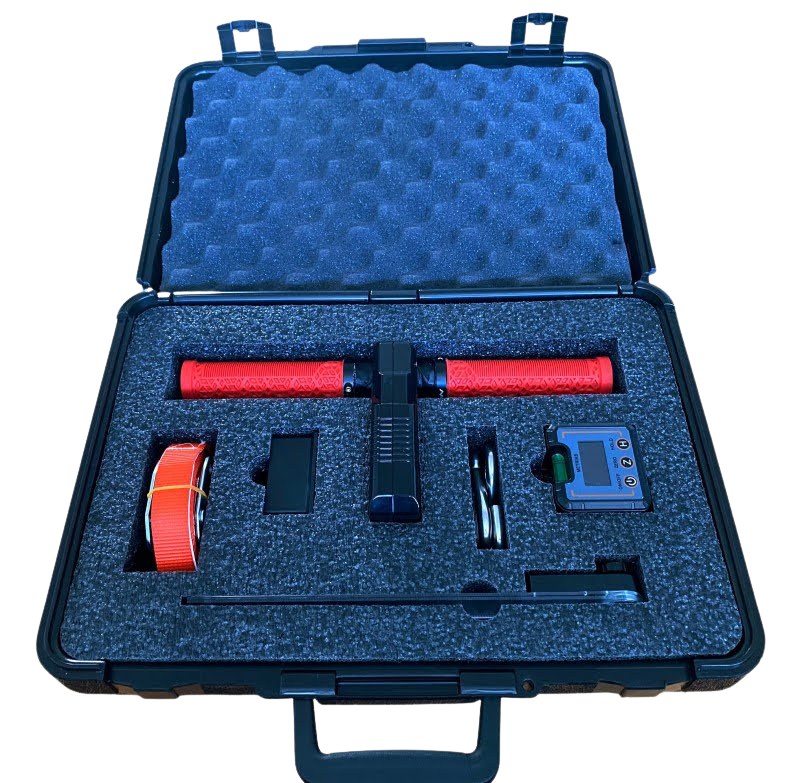
For example, using a force gauge to measure push and pull strength replaces estimates based on rolling chairs, shopping carts, friction, and improvised equipment with an actual force value. That is a meaningful improvement in measurement.
When Technology Adds Complexity Without Improving the Evaluation
Technology becomes less useful when it automates a step that is already fast, reliable, and easy for the evaluator to complete.
Computerized FCE systems have been developed to transfer measurements automatically from testing devices into the final report.
The idea sounds efficient.
A lift result moves from the scale to the software. A range-of-motion value moves from the measuring device to the report. Repetitions and force measurements transfer without being typed.
But the practical benefit must be compared with the additional technical system required to make that transfer happen.
Entering 24 lb or 45° takes only a few seconds.
Automatic transfer can introduce:
- Bluetooth connection failures;
- device-pairing problems;
- software-driver conflicts;
- firmware updates;
- operating-system compatibility issues;
- calibration dependencies;
- failed synchronization; and
- specialized technical support requirements.
If the automated transfer saves two seconds but creates a system that can fail at eight different points, it may not improve the evaluation process.
Data transfer creates substantial value when large volumes of data must move accurately and repeatedly between systems.
It creates much less value when the evaluator is transferring one short result at a time.
Why Metriks FCE Software Uses Selective Automation
Metriks FCE Software was built around a selective approach to technology.
We automate the parts of a Functional Capacity Evaluation that computers can perform faster and more reliably than a person, including:
- calculations;
- functional capacity classifications;
- job-demand comparisons;
- report organization;
- repeated documentation fields; and
- generation of an editable professional report.
The evaluator still uses appropriate clinical tools to obtain the measurement and enters the result into the software.
This avoids making the clinical testing equipment dependent on a complicated network of proprietary hardware connections.
The result is a simpler division of labour:
The clinician measures and interprets. The software calculates, organizes, and generates the report.
That approach preserves clinical judgment while reducing the part of the FCE process that creates the greatest administrative burden: converting a large volume of test findings into a clear final report.
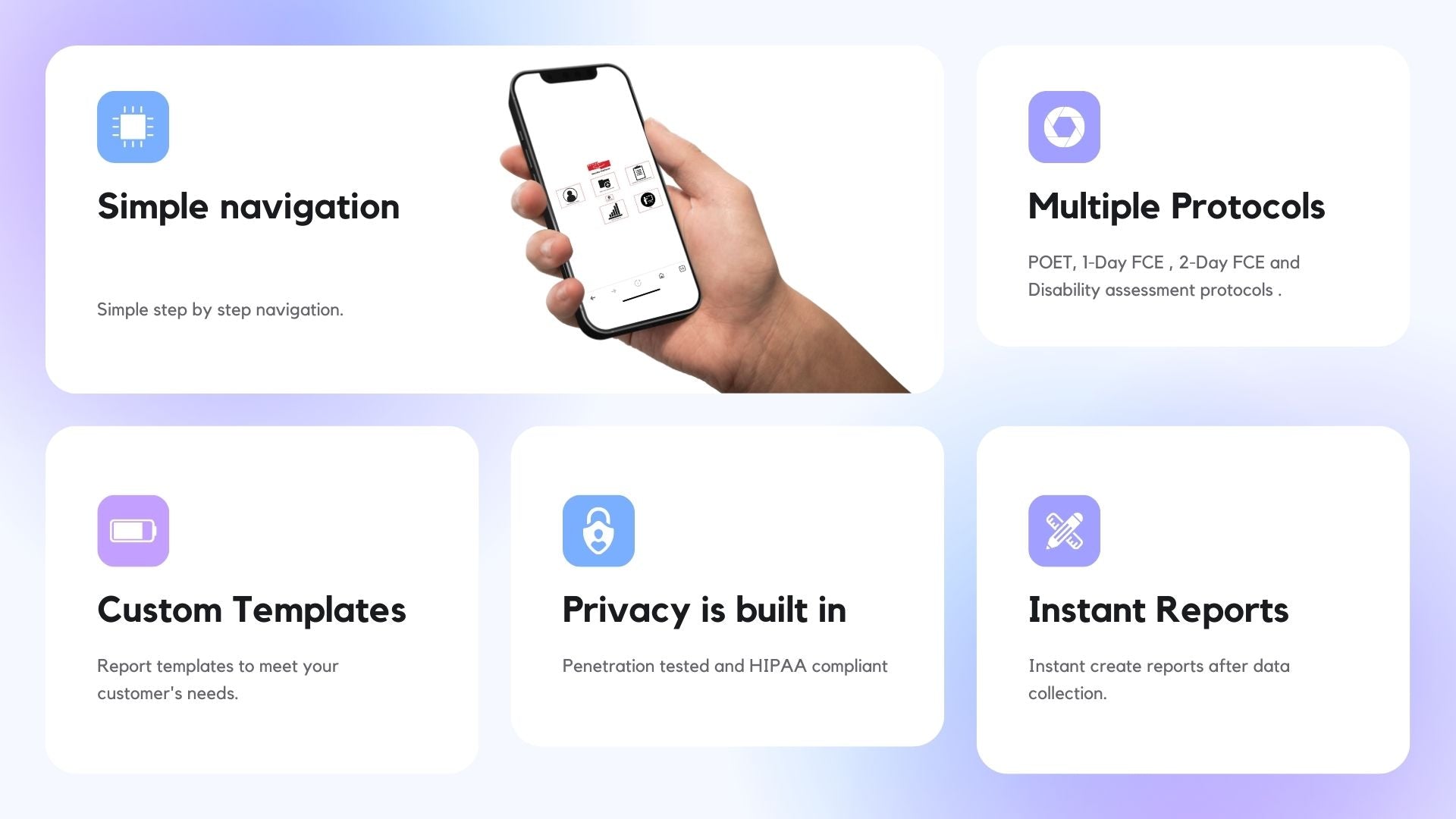
See how Metriks FCE Software supports Functional Capacity Evaluation testing and report generation.
A Practical Test for Evaluating New Technology
Before adding a new device, software platform, or automated feature to a Functional Capacity Evaluation process, ask four questions:
- What specific problem does this technology solve?
- Can that problem already be solved accurately and efficiently without it?
- Does the technology improve measurement, interpretation, documentation, or communication?
- Is the improvement greater than the complexity the technology introduces?
The connected World Cup ball passes that test.
It can identify a moment of contact that a camera may miss. It can also provide evidence when an apparent contact may be a visual illusion.
That is a problem humans cannot always solve reliably through observation.
Automatically transferring a single weight or angle into a report is different. The value of removing a two-second entry step may not justify the additional hardware, software, maintenance, and failure points required to support it.
The Better Technology Question
The wrong question is:
Can this be automated?
Almost anything can be automated with enough hardware, software, time, and money.
The better question is:
Does automating this step improve the quality or efficiency of the evaluation enough to justify the complexity?
The 2026 World Cup provided two high-profile examples of technology being used to resolve a genuine measurement problem.
That should be the standard in Functional Capacity Evaluation as well.
Use technology where it improves measurement.
Use software where it reduces calculation, documentation, and report-writing burden.
Do not add complexity simply because the connection can be made.
Frequently Asked Questions
What technology is inside the 2026 World Cup ball?
The Adidas Trionda contains a 500 Hz motion sensor that records ball movement 500 times per second. The data can help video match officials identify the precise moment of contact for decisions involving offside, handball, and other disputed touches.
What is the purpose of measurement technology in a Functional Capacity Evaluation?
Measurement technology should help the evaluator quantify functional performance that cannot be determined reliably through observation alone. Examples include force, weight, range of motion, heart rate, repetition, time, and consistency across repeated trials.
Does an FCE need fully computerized testing equipment?
No. An FCE requires appropriate, reliable, and valid methods for measuring functional performance. Digital or computerized tools may be useful, but automatic data transfer is not required for a high-quality evaluation.
What should FCE software automate?
FCE software is most valuable when it automates calculations, organizes test findings, compares performance with job demands, maintains consistent documentation fields, and generates a professional report. These tasks involve enough information and repetition for automation to create a meaningful time saving.
Why does Metriks use manual entry for clinical measurements?
Manual entry allows clinicians to use practical digital and mechanical measurement tools without making the entire evaluation dependent on proprietary device connections. Entering a short value takes seconds, while the software handles the larger administrative task of calculation and report generation.
Related Articles
- The Problem with Shopping Carts, Rolling Chairs, and Guessing: Measuring Push and Pull Strength in Functional Testing
- The Functional Shelf: A Standardized Lifting Assessment System for Functional Capacity Evaluations and Occupational Rehabilitation
- FCE in a Box: A Complete Functional Capacity Evaluation Hardware System for Rehab Professionals