The Problem with Shopping Carts, Rolling Chairs, and Guessing: Measuring Push and Pull Strength in Functional Testing
Measure Push, Pull, and Lift Strength Without Guessing
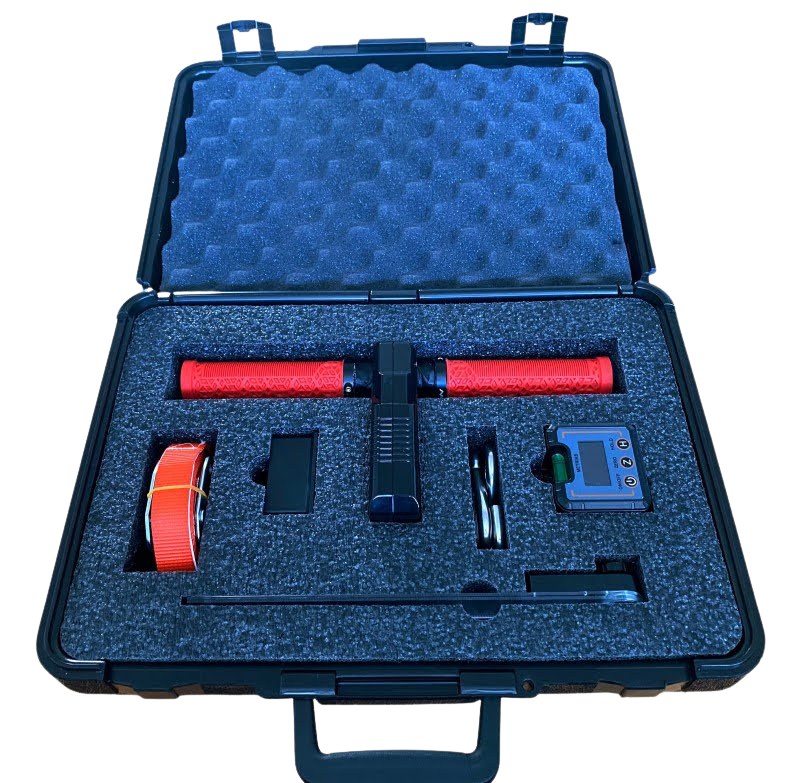
Get the exact force measurement system rehabilitation professionals use to quantify push, pull, and isometric lifting strength during functional testing, return-to-work assessments, job analyses, and Functional Capacity Evaluations. Delivered ready-to-use and trusted by clinics across North America.
Most rehabilitation professionals have seen some version of push and pull testing.
A worker pushes a loaded shopping cart.
A clinician loads a rolling chair with weight plates.
An ultrasound cart is pushed down a hallway.
Sometimes a proper industrial dolly is available.
None of these approaches are necessarily wrong.
The problem is that none of them may accurately represent the actual work task being evaluated.
The shopping cart is different from a pallet jack.
The rolling chair is different from a fuel hose.
The clinic floor is different from an icy loading dock in northern Alberta.
The wheels, surface friction, handle height, temperature, footwear, and load characteristics all influence the force required to move an object.
This is where isometric force measurement becomes valuable.
Rather than attempting to perfectly recreate every workplace task, the clinician can directly measure the amount of force a worker is capable of producing.
In many situations, this may be simpler, more repeatable, and more defensible than attempting to recreate a workplace task using substitute equipment inside a clinic.
That information can then be compared to known job demands, job analyses, or used as an objective measure of functional strength when job demands are unknown.
Like all functional testing methods, isometric force measurement should not be interpreted in isolation. It represents one piece of the larger clinical picture that may also include dynamic lifting, positional tolerance testing, cardiovascular response, biomechanics, symptom behavior, and overall functional performance. Current Functional Capacity Evaluation guidelines emphasize that meaningful conclusions require integration of multiple data sources rather than reliance on a single test result.
The Challenge of Measuring Push and Pull Capacity
Push and pull demands are among the most difficult work activities to replicate inside a clinic.
Consider these workers:
- A fuel truck operator pulling a frozen fuel hose at -40°C
- A food production worker pushing a 640 kg block of cheese
- A warehouse employee maneuvering loaded carts across uneven flooring
- A healthcare worker moving medical equipment through crowded hallways

Each task involves different equipment, surfaces, environmental conditions, and force requirements.
Attempting to recreate these exact conditions in a clinic is often impossible.
Even if the correct equipment were available, the clinic floor would rarely match the workplace.
The result is that clinicians frequently substitute available equipment and then attempt to estimate real-world capacity.
Isometric testing takes a different approach.
Rather than measuring whether a worker can move a specific object, the clinician measures how much force the worker can generate.
A calibrated force gauge allows push and pull forces to be quantified directly.
The same force gauge can also be used during a workplace assessment to quantify the force required to perform the actual job task. This creates a common measurement language between the clinic and the workplace.
When a job analysis has been performed using the same measurement approach, the comparison becomes straightforward:
- Job requires 55 lb of horizontal pull force
- Worker demonstrates 72 lb of pull force
Or:
- Job requires 75 lb of push force
- Worker demonstrates 42 lb of push force
In these situations, isometric testing may actually provide a more direct comparison than a dynamic clinic simulation.
This is particularly true when the clinic simulation bears little resemblance to the actual work task. A shopping cart may be easy to obtain, but it may have very little relationship to the equipment used on the job. Measuring force directly removes much of that uncertainty.
What If You Don't Know the Job Demands?
Many referrals arrive with incomplete information.
The clinician may receive:
- No job description
- No physical demands analysis
- No worksite measurements
Yet return-to-work decisions still need to be considered.
This is where isometric force testing remains useful.
Even without known job demands, force production can be objectively measured and documented.

If a worker demonstrates:
- 20 lb push force
- 18 lb pull force
that tells a different story than a worker demonstrating:
- 95 lb push force
- 85 lb pull force
Neither result automatically determines work ability.
However, both provide meaningful information regarding current functional strength.
As the APTA Current Concepts guideline notes, functional testing exists to provide objective measurements of functional ability rather than relying solely on estimates.
What Happens When a Worker Refuses Dynamic Lifting?
This situation is more common than many clinicians expect.
A worker may refuse to lift a crate from the floor because of:
- fear of reinjury
- high pain levels
- recent surgery
- medical restrictions
- concern about symptom aggravation
If dynamic lifting data cannot be obtained, the clinician still needs information regarding functional strength.
Isometric lift testing can provide another source of objective data.
Common testing positions include:
- Floor-level lift
- Waist-level lift
- Shoulder-level lift


Because the load does not move, some individuals tolerate isometric testing better than progressive dynamic lifting.
The resulting force measurements do not replace dynamic lifting performance.
However, they may provide useful information regarding available force production when dynamic testing cannot be completed.
This is especially valuable when interpreted alongside:
- range of motion findings
- positional tolerance testing
- symptom response
- observed biomechanics
- overall functional presentation
The Isometric Versus Dynamic Strength Debate
One of the longest-running discussions in occupational rehabilitation concerns the relationship between static and dynamic strength testing.
The research generally shows that static strength and dynamic lifting capacity are related, but not identical.

The Current Concepts guideline specifically notes that static lift testing has historically been used to infer dynamic lifting ability, but that static testing demonstrates poor predictive value when attempting to directly estimate dynamic lifting capacity. Dynamic lifting ability is best evaluated through dynamic lifting tests.
Several studies referenced within the guideline reached similar conclusions:
- Static testing does not accurately predict dynamic lifting performance.
- Static testing should not be used as a direct substitute for dynamic lifting assessment.
- Dynamic lifting remains the preferred method when the clinical question involves dynamic lifting capacity.
I agree with that conclusion.
If I want to know how safely a worker can perform repetitive floor-to-waist lifting, I would rather observe progressive dynamic lifting.
Dynamic testing provides information regarding:
- lifting mechanics
- cardiovascular response
- movement quality
- load control
- fatigue
- symptom behavior
None of those can be fully evaluated during a static pull against a fixed object.
However, I think the debate often misses an important practical point.
The real-world choice is not always:
- Dynamic data versus isometric data
Often the choice is:
- Isometric data versus no strength data at all
When viewed through that lens, isometric force measurement becomes extremely valuable.
A properly performed isometric test may not tell us everything.
But it tells us far more than guessing.
Isometric Testing Should Be Part of a Larger Functional Testing Strategy
One of the key principles in modern functional testing is that conclusions should never be based on a single test.
Current FCE guidelines recommend integrating multiple sources of information when determining functional abilities and limitations.
That may include:
- isometric force measurement
- progressive lift testing
- positional tolerance testing
- walking tolerance
- range of motion
- cardiovascular response
- symptom reports
- observed biomechanics
Each test contributes a different piece of information.
The goal is not to find a perfect test.
The goal is to gather enough objective information for functional limitations and risks of harm to emerge.
Practical Takeaway
If you have access to dynamic lifting tests, use them.
If you have access to workplace force measurements, even better.
But do not underestimate the value of isometric force measurement.
Push and pull forces are often difficult to reproduce accurately in a clinic.
Dynamic lifting is not always tolerated.
Job information is not always available.
In those situations, a calibrated force gauge can provide objective, repeatable measurements that help quantify functional strength, document progress over time, compare clinic findings to workplace demands, and support return-to-work decision making.
Isometric force measurement does not replace dynamic testing.
It complements it.
When dynamic testing is unavailable, poorly tolerated, or does not accurately represent the work task, objective force measurement may provide some of the most useful functional strength data available to the clinician.
Measure Force. Stop Guessing.
If you currently assess push and pull strength using shopping carts, rolling chairs, weighted trolleys, or improvised clinic equipment, a force gauge may provide a simpler and more objective alternative.
The Metriks Force Gauge System allows rehabilitation professionals to measure:
- Push force
- Pull force
- Isometric lifting force
- Workplace force demands
- Changes in strength over time
Whether you perform occupational rehabilitation, return-to-work assessments, job analyses, or Functional Capacity Evaluations, objective force measurement can help replace estimates with data.
Related Articles
Frequently Asked Questions
Is isometric strength testing the same as dynamic lifting testing?
No. Isometric testing measures force production against a fixed object, while dynamic testing measures force production during movement.
Can isometric testing predict lifting capacity?
Research suggests the relationship is limited. Dynamic lifting capacity is best evaluated using dynamic lifting tests. However, isometric testing can still provide useful information regarding functional strength.
Why use a force gauge during push and pull testing?
A force gauge provides objective measurements that can be compared to workplace force requirements obtained during job analysis.
What if a worker cannot complete dynamic lifting?
Isometric lift testing may provide useful supplemental information regarding available force production when dynamic testing cannot be performed.
Should return-to-work decisions be based solely on isometric testing?
No. Functional testing should integrate multiple sources of information, including strength, biomechanics, symptom response, positional tolerance, and overall functional performance.
References
- Academy of Orthopaedic Physical Therapy, APTA. Current Concepts in Functional Capacity Evaluation: A Best Practices Guideline. Adopted April 30, 2018.
- MacMasters W, Allison S, Wickstrom R, McMenamin P. Functional Capacity Evaluation and Disability Determination. Academy of Orthopaedic Physical Therapy, APTA.
- Feeler L, St James JD, Schapmire DW. Isometric strength assessment, part I: static testing does not accurately predict dynamic lifting capacity. Work. 2010;37(3):301-308.
- Townsend R, Schapmire DW, St James J, Feeler L. Isometric strength assessment, part II: static testing does not accurately classify validity of effort. Work. 2010;37(4):387-394.
- Keyserling WM, Herrin GD, Chaffin DB, Armstrong TJ, Foss ML. Establishing an industrial strength testing program. American Industrial Hygiene Association Journal. 1980;41(10):730-736.