Why We Use a Force Gauge to Measure Push and Pull in an FCE
Why We Use a Force Gauge to Measure Push and Pull in an FCE
By Kevin Cairns, Metriks Education Inc.
A force gauge measures the force a person produces during a Functional Capacity Evaluation (FCE) and the force a job requires during a Job Demands Analysis (JDA). That gives us a useful basis for comparison. The weight loaded onto a cart or sled does not provide the same information.
Consider this result: “The person pushed a sled loaded with 30 lb.”
How much force did they produce? Could they push a workplace cart? Would the same sled require the same effort on another clinic’s floor?
The loaded weight alone cannot answer those questions. It tells us what was on the sled. It does not tell us the horizontal force required to move it.
This is why I use a force gauge for push/pull testing. It is practical, measures the quantity we need, and connects the FCE to the way push/pull demands are measured at work. Understanding that connection also changes how we think about static testing, validity and reliability.

Start with the practical question
Given a choice between repeatedly loading weights onto a cart and having a person push against a fixed surface through a force gauge, the simpler setup is clear.
A static push test requires little space. There is no cart to load, no travel lane to clear and no moving load to return to its starting position. With a suitable fixed anchor, the same principle applies to pulling.
The person progressively produces force while the assessor monitors performance and symptoms. Testing can stop when the assessment question has been answered or an appropriate endpoint has been reached. There is no need to find a maximum simply because the instrument can measure one.
Convenience matters in an FCE. But convenience alone would be a weak reason to choose a test. The stronger question is whether we are measuring what we need to know.
Validity: what are we actually trying to measure?
Validity concerns whether a test supports its intended measurement and interpretation.
At first glance, pushing a cart seems more valid than pushing against a wall. People push carts at work. Few jobs involve trying to move a wall.
That is an argument about face validity: how closely a test appears to resemble the activity of interest. It is worth considering, but appearance does not establish that the demand is equivalent.
Is pushing a wheeled cart across a smooth clinic floor equivalent to pushing a wooden skid across a warehouse floor? What if the workplace cart has smaller wheels, a lower handle or a caster that does not swivel properly?
Both tasks involve pushing. Their resistance may be very different. CCOHS identifies wheel characteristics, floor conditions and task design as important contributors to cart-handling demands. [1]
To make the comparison useful, we need to go one step further: How was the workplace demand measured?

During a JDA, a force gauge can measure the force required to start and move the object. The relevant result is then expressed as force, rather than merely as the weight of the object being moved.
A static push test also measures force. It measures what the person can produce in a documented position. That makes it relevant to the force requirement identified by the JDA, even though the test does not visually reproduce the entire job.
The interpretation still needs to match the measurement. A brief static effort provides evidence about force production in that position. Distance, repetition, steering and sustained movement remain additional questions. Using the same units creates a meaningful comparison; it does not make every aspect of the two tasks interchangeable.
Why does an 85 lb sled register only about 40 lb on the gauge?
Because the person is moving the sled horizontally rather than lifting its full weight.
Think of pushing a friend sitting in an office chair. You do not lift your friend and the chair. You apply enough force to get the chair rolling and keep it moving.
For the sled example, the floor supports the loaded sled. The person supplies the horizontal force needed to overcome resistance and, while speeding it up, accelerate it. If the gauge reads about 40 pounds-force under those conditions, that is the measured force transmitted through the gauge—not 85 pounds-force.
This is an example, not a conversion rule. An 85 lb loaded sled will not always require 40 pounds-force. Also distinguish the added weights from the total weight of the sled plus its contents.
The physics behind the reading
For a simplified horizontal push on a level surface:
Applied force − resisting force = mass × acceleration.
When the object speeds up, applied force exceeds resistance. At constant speed in a straight line, those forces balance. The net force is then zero, but the person is still applying force to overcome resistance. [2]
For a sliding sled, a basic friction model estimates resistance during sliding as:
Sliding resistance = coefficient of kinetic friction × normal force.
With a horizontal pull on a level floor, normal force is approximately the total weight supported by the floor. An upward or downward component of the applied force changes that relationship. Starting resistance involves static friction, which can differ from sliding friction. [3]
A wheeled cart has rolling resistance, wheel and bearing behaviour, and potentially caster-swivelling resistance. Treating it as a sliding sled with the same friction coefficient would be inappropriate. Floor condition and wheel design matter. [1]
You do not need to calculate every source of resistance to measure the force required. A correctly positioned force gauge measures their combined effect under the conditions being tested.
Use force units in the report
Report push/pull force in newtons (N) or pounds-force (lbf). A force instrument may display “lb,” but the quantity being measured is pounds-force. One pound-force is approximately 4.45 N.
For example, 40 lbf is approximately 178 N. It describes the push or pull transmitted through the gauge. It does not describe the weight of the object, the load on an individual joint, or the weight the person can lift.
How can the gauge measure force when the wall does not move?
Force does not require visible movement.
When the person pushes through the gauge against a fixed surface, the surface provides an opposing reaction. The gauge measures the force transmitted through it. A digital force gauge typically uses a load cell: a sensing element deforms very slightly under load, and the instrument converts the resulting signal into a force reading.
The wall remains stationary, but the person is producing force. The reading is a measure of external force output in that test setup. Posture, handle height, grip, footing and body position all influence the result.
This also explains why gauge alignment matters. A gauge intended to measure along one axis must be aligned with the intended force direction. An angled pull is not automatically a measurement of horizontal force, and force applied through another hand directly to the cart can bypass the instrument. [4]
Does the evidence justify dismissing static push/pull testing?
The 2018 Current Concepts in Functional Capacity Evaluation: A Best Practices Guideline recommends using a calibrated force gauge for push/pull testing. It recognizes that the object, surface and acceleration affect the force required. It also recommends progressive testing and attention to the height at which force is applied. [5, p. 15]
However, its residual functional capacity discussion recommends avoiding static strength tests to determine functional abilities unless a job-specific static requirement exists. The reasoning immediately before that recommendation refers to research on predicting dynamic lifting capacity and potential safety concerns during static lifting. [5, p. 18]
Those distinctions matter.
Feeler and colleagues studied whether three static lifting tests could predict four dynamic lifting performances. Their findings did not support using those static lifts to predict dynamic lifting capacity accurately. That is a finding about lifting prediction. The study described in the abstract did not evaluate a horizontal wall push against measured workplace pushing demands. [6]
The other cited study, by Hansson and colleagues, examined lumbar loading during isometric strength testing in particular positions. Its reported concerns included high compressive loads during squat and torso lifting. That does not directly establish the safety or validity of a different push/pull protocol. [7]
My objection is to extending those findings into a general dismissal of static push/pull force measurement. The cited evidence does not directly answer that question. Equally, identifying that gap does not prove that every static push protocol predicts every dynamic pushing task.
The clinical argument is more specific: measure the person’s force production, compare it with the measured force demand, and assess the other functional requirements that influence the final ability rating.
Reliability: would we obtain a consistent measurement?
Reliability concerns the consistency of measurements when the underlying ability has not meaningfully changed.
For push/pull testing, there are several questions: would the same assessor obtain a similar result on another occasion? Would a different assessor obtain a similar result using the same procedure? Does the instrument itself measure consistently?
A static setup removes some sources of variation. There are no cart wheels to realign and no moving sled whose resistance changes along the travel path. That makes the setup easier to control. It is a practical advantage—not, by itself, proof of superior reliability.
The procedure still needs to be standardized.
| What to control | Why it matters |
|---|---|
| Gauge calibration, zero and units | A consistent-looking number can still be inaccurate. |
| Handle height, grip and force direction | These affect how force is generated and measured. |
| Foot position, footwear, floor and bracing | Changes can alter traction and mechanical advantage. |
| Instructions and progression | A gradual effort and a sudden thrust are different procedures. |
| Effort duration, rest and trial sequence | Fatigue, recovery and familiarization can affect performance. |
| Endpoint and scoring rule | Peak force, a held force and an average are different outcomes. |
For dynamic tests, add the cart or sled, total load, load distribution, wheel condition, starting caster orientation, route and movement speed.
The 2018 guideline explicitly asks examiners to consider device, inter-rater, intra-rater and inter-session reliability. [5, p. 7] That is a more useful standard than assuming a test is reliable because the equipment looks substantial or the display has decimal places.
When reviewing repeated measurements, consider agreement and measurement error as well as whether people retain the same rank relative to one another. A small numerical difference should not automatically be interpreted as a real improvement or decline. Conversely, a change in symptoms or fatigue may represent a real change in performance rather than instrument error.
Initial force and sustained force answer different questions
Initial force is the force required to get the object moving from rest. Sustained force is the force required to keep it moving under the specified conditions.
Initial force is often higher. Starting a load may involve overcoming starting resistance, orienting casters and accelerating the object. HSE distinguishes starting forces from forces required to keep a load moving and notes the additional demands associated with changes in direction. [8]
For illustration, a job might require 40 lbf to start a cart and approximately 18 lbf to keep it moving along a level route. Those are two different demands, not two competing measurements of the same thing.
A person who briefly produces 40 lbf has demonstrated that force in the tested position. Whether they can sustain the required moving force over the route, repeat the task or control the cart through a turn requires additional interpretation or testing.
Also, initial force and peak force are not synonymous. The highest reading over an entire trip might occur at a floor joint or during a turn rather than at the start. A peak-hold display retains a maximum; it does not identify when that maximum occurred or describe the sustained force. [9]
How to use a force gauge with a cart or sled
A cart or sled can provide useful information when movement is part of the assessment question. Adding a force gauge allows you to quantify the resistance while observing the task.
-
Define the task. Identify the relevant push or pull direction, application height, route, distance, pace and repetition. Choose conditions that answer the referral question.
-
Set up the measurement. Use suitable attachments and a secure arrangement that directs the intended force through the gauge. Check its range, calibration status, zero and display units. For a push, use an appropriate compression arrangement; a loose strap transmits tension for pulling, not compression for pushing.
-
Measure the start separately. Begin from rest and apply force progressively. Identify the force associated with starting the load. Avoid introducing an unnecessary jerk that inflates the reading through rapid acceleration.
-
Measure the moving phase. Once moving at the specified pace, record force over a defined segment. Use a live reading or recording system appropriate to the instrument. State whether you report a range, an average or another defined measure. A retained startup peak cannot serve as the sustained-force result.
-
Assess relevant changes in the task. If turning, repeated starts or a particular surface transition matters, measure and describe it separately rather than hiding it inside a single number.
-
Progress and document. Adjust resistance as needed and remeasure it. Record the achieved force, task conditions, observations and endpoint. Stop when the objective is met or the appropriate clinical endpoint is reached.
HSE’s measurement guidance emphasizes transmitting the force through the dynamometer, applying it in the correct direction, avoiding excessive acceleration and repeating measurements to check consistency. [4]
The useful report now says how much force the person exerted while performing a defined task. “Pushed a cart containing 100 lb” remains equipment information; it is not a substitute for that measurement.
How I use the findings in the final ability rating
I use a static push/pull measurement to establish the force the person can produce under the test conditions.
Because pushing and pulling often involve movement, I also perform a walk test to assess movement limitations and a carry test to assess performance when the joints are loaded. I consider those findings alongside symptoms, observed mechanics and the measured push/pull force when determining the final ability rating.
Walking and carrying contribute different pieces of information. They do not mechanically reproduce every aspect of pushing a cart, and I do not use a numerical formula to convert them into push capacity. Their value is in the combined clinical interpretation.
If the referral question specifically concerns sustained cart movement, repeated starts or manoeuvring, a dynamic task with measured resistance can add the information needed.
This follows the same principle used when building an FCE protocol: choose tests around the person, the referral questions and the job demands.
What should the report say?
Make the measurement and its conditions explicit. For example:
Illustrative static result: Demonstrated 40 lbf of horizontal push force in a standing, two-handed test at a documented handle height. This represents the force achieved in the tested position. Walking, carrying, symptom response and observed mechanics were considered when determining the final ability rating.
Illustrative dynamic result: Moved the loaded cart over the documented level route. Measured starting force was 40 lbf, with moving force ranging from 16–20 lbf over the specified steady-movement segment. Handle height, travel distance, pace, repetitions and test endpoint were recorded separately.
These examples describe different measurements. In an actual report, include the specific height, distance, duration, trial results and endpoint rather than leaving those details implicit. If the test ended because the required demand was met, say so; do not describe that result as maximum capacity.
Frequently asked questions
Can I report the weight on the sled as the person’s push capacity?
No. Record it as part of the equipment setup. Report measured push/pull force separately because loaded weight does not establish the resistance the person overcame.
Can I use a static wall push in an FCE?
Yes, to measure force production in a defined position. In my approach, I interpret it alongside walking, carrying and other relevant findings. The final conclusion should address the job’s movement, duration and repetition requirements as well as force.
Is a cart automatically a more valid test because it moves?
No. Movement adds functional information, but it does not establish that the clinic cart’s resistance matches the work demand. Measure the force and consider how the remaining task conditions compare.
Can I calculate push force from the sled’s loaded weight?
Only with additional assumptions about resistance and movement. Those assumptions may not describe the actual setup. Direct force measurement avoids treating an estimated friction coefficient as though it were a measured demand.
Should I record initial force or sustained force?
Record both when both are relevant. Identify the phase of movement and the method used. A single peak reading does not describe the force required throughout the task.
Measure the demand you intend to compare
A cart or sled can be a useful testing tool. A static setup can be a practical way to measure force production. Both require a clear procedure and an interpretation that matches the findings.
The question is whether the assessment measures the demand you intend to compare with work. For push/pull force, that begins with a force measurement.
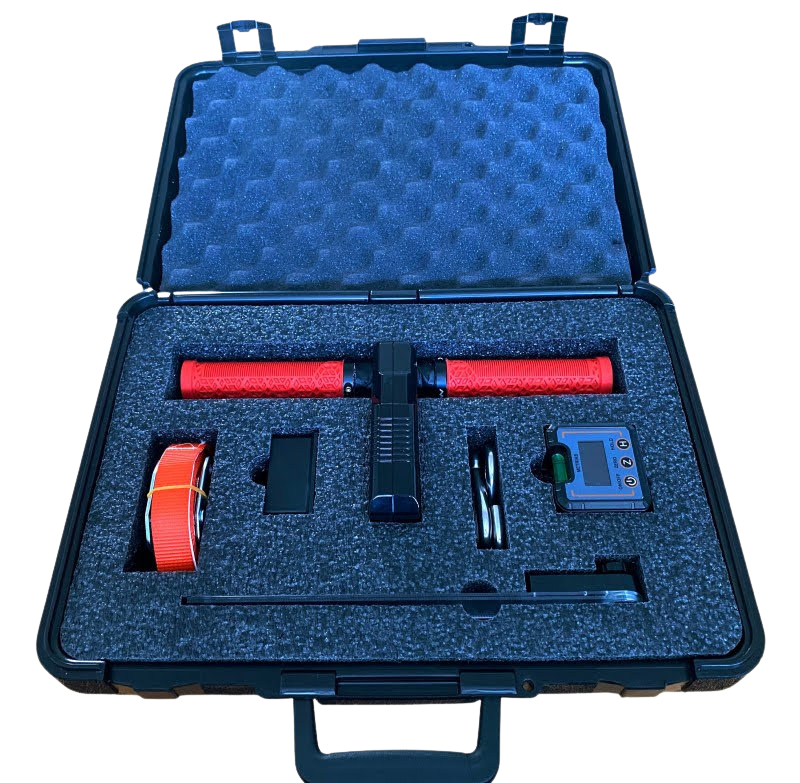
The Metriks Push/Pull Force Gauge can be used for clinical force measurement and workplace demands assessment. To develop your approach to test selection, observation and reporting, explore Metriks FCE Certification.
References
-
Canadian Centre for Occupational Health and Safety. Pushing and Pulling—Handcarts.
-
OpenStax. University Physics, Volume 1: Newton’s Second Law.
-
OpenStax. University Physics, Volume 1: Friction.
-
Health and Safety Executive. Doing a push/pull risk assessment: measuring forces.
-
Current Concepts in Functional Capacity Evaluation: A Best Practices Guideline. Adopted April 30, 2018. Supplied source, printed pages 7, 15 and 18; references 139–140.
-
Feeler L, St James JD, Schapmire DW. Isometric strength assessment, part I: static testing does not accurately predict dynamic lifting capacity. Work. 2010;37(3):301–308. Abstract reviewed.
-
Hansson TH, Bigos SJ, Wortley MK, Spengler DM. The load on the lumbar spine during isometric strength testing. Spine. 1984;9(7):720–724. Abstract reviewed.
-
Health and Safety Executive. Manual Handling, L23, paragraphs 127–129.
-
Mark-10. Series 7 Digital Force Gauges: User’s Guide. Reference for real-time and peak-display behaviour, not a claim about Metriks gauge specifications.