How Do I Prepare If My Functional Capacity Evaluation Gets Called To Court?
Most Functional Capacity Evaluations never end up in court. But every FCE should be documented as though someone may ask you to explain it two years later.
A Functional Capacity Evaluation is not just a report.
It is a clinical record of how you measured functional ability, how you interpreted performance, and how you connected the findings to a referral question, job demand, disability question, work conditioning decision, or return-to-work recommendation.
That distinction matters when an FCE is challenged.
When a report is reviewed by an attorney, insurer, peer reviewer, utilization review agent, expert witness, or court, the question is rarely limited to whether the final report was well written.
The questions are more basic:
- What did you review before testing?
- Why did you choose those tests?
- What job demands were used?
- What data supports the conclusion?
- Did the person demonstrate consistent performance?
- Were the limitations injury-related, non-injury-related, or unclear?
- Can another evaluator follow your reasoning?
- Can you produce the underlying assessment data if someone asks?
This is why defensible FCE practice begins long before a subpoena arrives.
It begins with the referral question, the intake process, the selection of test components, the documentation of observations, the preservation of raw data, and the ability to explain how the final opinion was formed.
What Makes A Functional Capacity Evaluation Legally Defensible?
A legally defensible Functional Capacity Evaluation is not defensible because it came from a specific software program, a specific report template, or a brand name protocol.
Those tools may help.
But the legal strength of an FCE comes from the clinical reasoning and documentation behind it.
The Metriks position on legal defensibility is based on three practical principles:
- Evidence-based methods: the evaluator uses functional tests and clinical procedures that are supported by research, accepted practice, or clear clinical rationale.
- Situation-specific design: the evaluation is adapted to the injury, referral question, job demands, jurisdiction, and reason the FCE was requested.
- Evaluator expertise: the assessor has the training, judgment, and documentation habits required to select tests, interpret results, and explain conclusions.
This is important because there is no universal external accreditation system that automatically makes an FCE protocol legally defensible. Legal defensibility is created through method, relevance, documentation, and professional judgment.
A one-size-fits-all test battery can look impressive, but it may still be vulnerable if the evaluator cannot explain why those tests were chosen for that person, that injury, that job, and that referral question.
The stronger approach is to document the connection between:
- the reason for referral,
- the medical and claim context,
- the physical demands being considered,
- the tests selected,
- the observations recorded,
- the raw data collected, and
- the conclusions stated in the report.
That chain is what allows an evaluator to explain the report later.
Legal Defensibility Starts Before The Evaluation Begins
Many FCE problems begin before the first lift, carry, push, pull, or positional tolerance test is performed.
The evaluator receives a referral that says:
"Please complete an FCE."
That is not enough.
A defensible FCE starts by clarifying the purpose of the evaluation.
Is the FCE being requested to determine current functional capacity? Is it being used for return-to-work planning? Is the referral source asking whether the worker can perform a specific job? Is the FCE being used to support work conditioning authorization? Is the question related to case closure, impairment, disability, litigation, accommodation, or vocational planning?
Different questions require different emphasis.
A job-specific FCE should be anchored to specific job demands. An any-occupation FCE may require classification of broader physical demand levels. A work conditioning FCE should identify the functional gap between the worker's current ability and the job demands the program is intended to restore. A litigation-related FCE may require more detail regarding causation, consistency, performance validity, and the limits of the evaluator's opinion.
Before testing, the evaluator should be able to identify:
- who requested the FCE,
- what question the FCE is supposed to answer,
- what records were available,
- what job demand information was available,
- what conditions are accepted, disputed, or outside the claim,
- whether the person is medically stable enough for testing, and
- what limits should be respected during testing.
If the referral question is vague, the report should say so.
If the job demands are incomplete, the report should say so.
If the evaluator must rely on the worker's description, a generic occupational source, or a job description that lacks physical detail, the report should say so.
These statements do not weaken the report. They make the report more transparent.
What Are Attorneys Actually Looking For?
When an FCE is challenged, evaluators often imagine being asked one narrow question:
"Why did you say this person could only lift 40 pounds?"
That question may come up.
But the broader challenge is usually about the foundation of the opinion.
An attorney, peer reviewer, or opposing expert may ask:
- What information did you review before the evaluation?
- Did you review the job description?
- Was the job description employer-verified?
- Did you rely on the worker's description of the job?
- Did you use DOT, O*NET, ORS, a physical demands analysis, or an employer-provided job description?
- Why were those tests selected?
- What makes those tests relevant to the referral question?
- What endpoints were used to stop testing?
- What physiological, biomechanical, or psychophysical responses were observed?
- How did you assess consistency of effort?
- What did you do with inconsistent findings?
- What data was included in the final report?
- What data was collected but not displayed in the final report?
- What calculations were performed?
- Can you produce the original entered values?
- Could another evaluator reproduce your reasoning from the record?
These are not just courtroom questions.
They are also quality assurance questions.
They are peer review questions.
They are utilization review questions.
They are audit questions.
The evaluator who can answer them from the record is in a much better position than the evaluator who must rely on memory.
The Questions You Should Be Able To Answer Five Years Later
A useful way to test the defensibility of your FCE is to imagine receiving a phone call five years from now.
The report is being reviewed.
You do not remember the person.
You do not remember the testing session.
You do not remember the referral source.
All you have is the documentation.
Could you still answer these questions?
- What was the reason for referral?
- What records were reviewed?
- What did the worker report during the interview?
- What job demands were considered?
- Were those job demands verified by the employer?
- What physical examination findings were relevant?
- What functional tests were performed?
- Why were those tests clinically relevant?
- What was the safe maximum performance?
- What signs limited performance?
- What physiological responses were recorded?
- What symptoms were reported before, during, and after testing?
- What movement strategies or compensations were observed?
- What effort and consistency indicators were considered?
- How did the final recommendations follow from the data?
If the documentation can answer those questions, the FCE is much easier to defend.
If the documentation cannot answer those questions, the evaluator may be left trying to reconstruct the reasoning from a final narrative report that was never designed to preserve every assessment detail.
Why Accepted Methodology Matters
An FCE opinion should not appear to be a personal preference.
It should be connected to accepted methodology.
The Current Concepts in Functional Capacity Evaluation describes an FCE as a comprehensive performance-based medical assessment of an individual's physical and/or cognitive abilities to safely participate in work and other major life activities. It identifies four major components: intake interview, medical records review, physical examination, and content-valid functional testing.
That framework is useful because it reminds the evaluator that an FCE conclusion should not come from a single number.
A lifting result alone is not the whole opinion.
A pain score alone is not the whole opinion.
A questionnaire alone is not the whole opinion.
A coefficient of variation alone is not the whole opinion.
Defensible FCE conclusions are formed by integrating multiple sources of information:
- history and medical records,
- self-reported function,
- physical examination findings,
- functional performance testing,
- symptom response,
- physiological response,
- biomechanical response,
- performance consistency,
- job demand information, and
- clinical judgment.
This is also why a defensible FCE report should not overstate what the evaluation can prove.
An FCE can provide objective, performance-based information about current functional ability under the conditions tested.
It can help support return-to-work planning, disability determination, work conditioning decisions, restrictions, accommodations, and case resolution.
But the FCE does not independently determine legal entitlement, claim acceptance, final benefit status, or every medical causation question.
The evaluator should stay within the scope of the evaluation and clearly identify the basis for each opinion.
The Documentation Trail Behind Every FCE Opinion
Every FCE conclusion should have a documentation trail.
For example, if the report states that the worker did not demonstrate the ability to return to full duty, the reader should be able to see:
- the job demands being considered,
- the worker's tested capacities,
- the gap between capacity and demand,
- the specific tasks that were not met,
- the reasons testing stopped or performance was limited,
- whether effort was considered valid, partially valid, or limited, and
- how the recommendation follows from the findings.
If the report states that the worker can perform modified work, the reader should be able to see:
- what physical demand level was demonstrated,
- what restrictions are recommended,
- what accommodations may be needed,
- whether the restrictions are temporary or likely permanent, and
- whether additional treatment, work conditioning, or vocational planning is recommended.
If the report states that the person demonstrated inconsistent performance, the reader should be able to see:
- which findings were inconsistent,
- whether inconsistencies occurred across repeated trials,
- whether symptoms, fear, fatigue, misunderstanding, or motor control problems could explain the variability,
- whether physiological or biomechanical responses supported the observed performance, and
- how the evaluator handled the inconsistency in the final opinion.
The key is traceability.
Can the reader trace the conclusion back to the evidence?
If yes, the report is easier to defend.
If no, the report becomes vulnerable even if the final opinion was clinically reasonable.

Raw Data Retention And Audit Trails
The final FCE report is the document most people read.
But the final report is not the entire assessment record.
During a Functional Capacity Evaluation, the evaluator may collect far more information than appears in the final narrative.
This may include:
- raw lifting values,
- push and pull force values,
- grip and pinch trials,
- heart rate values,
- RPE scores,
- pain reports,
- positional tolerance times,
- range of motion measurements,
- questionnaire scores,
- calculation fields,
- test comments,
- missing or incomplete fields, and
- data that supports but does not appear in the final report.
When a report is challenged, the request may be simple:
"Show me the raw data."
That request matters because raw data allows the evaluator, peer reviewer, attorney, or expert witness to examine the information behind the report.
Raw data retention helps answer questions such as:
- What values were entered?
- Were calculations based on the entered data?
- Were any fields left blank?
- Did the final report omit supporting information?
- Can the evaluator verify the numbers behind the conclusion?
- Was the assessment record preserved beyond the final report?
This is where software can support defensible practice.
Metriks stores the underlying assessment data used to create the FCE report and provides access to a comprehensive raw data export. This gives the evaluator another layer of transparency for quality assurance, peer review, expert witness work, and litigation support.
The practical value is not just report generation.
The practical value is preserving the assessment record behind the report.
Texas Example: Documentation Gets Challenged Before Court
Texas workers' compensation provides a useful example because FCE documentation can be scrutinized before a case reaches a courtroom.
In Texas, disputes involving FCEs and work conditioning often focus on whether the documentation supports medical necessity, whether the worker has reached or is approaching maximum medical improvement, whether there is a documented functional gap, whether the job demands are specific and employer-verified, and whether the FCE results are valid enough to support the requested program.
In one Texas Medical Contested Case Hearing, a treating doctor recommended a Functional Capacity Evaluation to determine work abilities. The carrier denied the FCE, the denial was appealed, and the Independent Review Organization upheld the denial. The reviewer focused on whether the Official Disability Guidelines supported the FCE under the circumstances, whether the person had reached or was about to reach maximum medical improvement, and whether the records established medical necessity for the requested FCE.
That case is useful because it shows that the FCE may be challenged before the evaluation is even completed.
The issue was not whether the final FCE report was well formatted.
The issue was whether the available documentation justified the evaluation.
In another Texas contested case involving work hardening, the records discussed FCEs performed on June 15, 2011 and December 20, 2011. The reviewing physician considered the claimant's pre-injury physical demand level, the FCE findings, whether the claimant could return to work without restrictions, whether there was a valid mismatch between job demands and demonstrated ability, and whether the FCE showed less than consistent and maximum effort.
That example is even closer to the problem experienced evaluators face.
The FCE became part of the reasoning chain used to determine whether additional occupational rehabilitation was medically necessary.
The questions were not abstract.
They were practical:
- What were the job demands?
- What did the FCE show?
- Was there a mismatch between capacity and demand?
- Was the worker's effort consistent?
- Did the FCE support the requested intervention?
Those are exactly the questions your documentation should be prepared to answer.
Texas Work Conditioning Workflow: Why The FCE Becomes The Evidence
The Texas work conditioning workflow also shows why FCE documentation has to be built carefully.
The typical sequence is:
- Traditional physical therapy reaches a plateau.
- The therapist documents persistent functional limitations.
- The physician orders an FCE.
- The FCE measures material handling, non-material handling, positional tolerance, and effort/consistency.
- The evaluator compares current ability to job demands.
- The treating doctor reviews the FCE and signs a plan of care.
- The clinic submits the work conditioning preauthorization request.
- A utilization review agent or peer reviewer evaluates the documentation.
- A peer-to-peer discussion may occur.
- The program is approved, denied, or modified.
At each step, the FCE may be questioned.
The reviewer may ask why the FCE was ordered. The treating doctor may ask what the functional gap is. The carrier may ask whether the job demands are documented. The peer reviewer may ask whether the worker meets work conditioning criteria. The attorney may later ask whether the FCE conclusions were based on objective findings.
This is why the FCE should clearly identify:
- the worker's current tested capacity,
- the specific job demands being considered,
- the gap between capacity and demand,
- the validity and consistency of performance,
- the data supporting the recommendation, and
- the relationship between the FCE and the requested program or return-to-work decision.
The same documentation chain that supports work conditioning authorization also supports peer review, audit response, expert opinion, and litigation.

How Metriks Preserves The Assessment Record
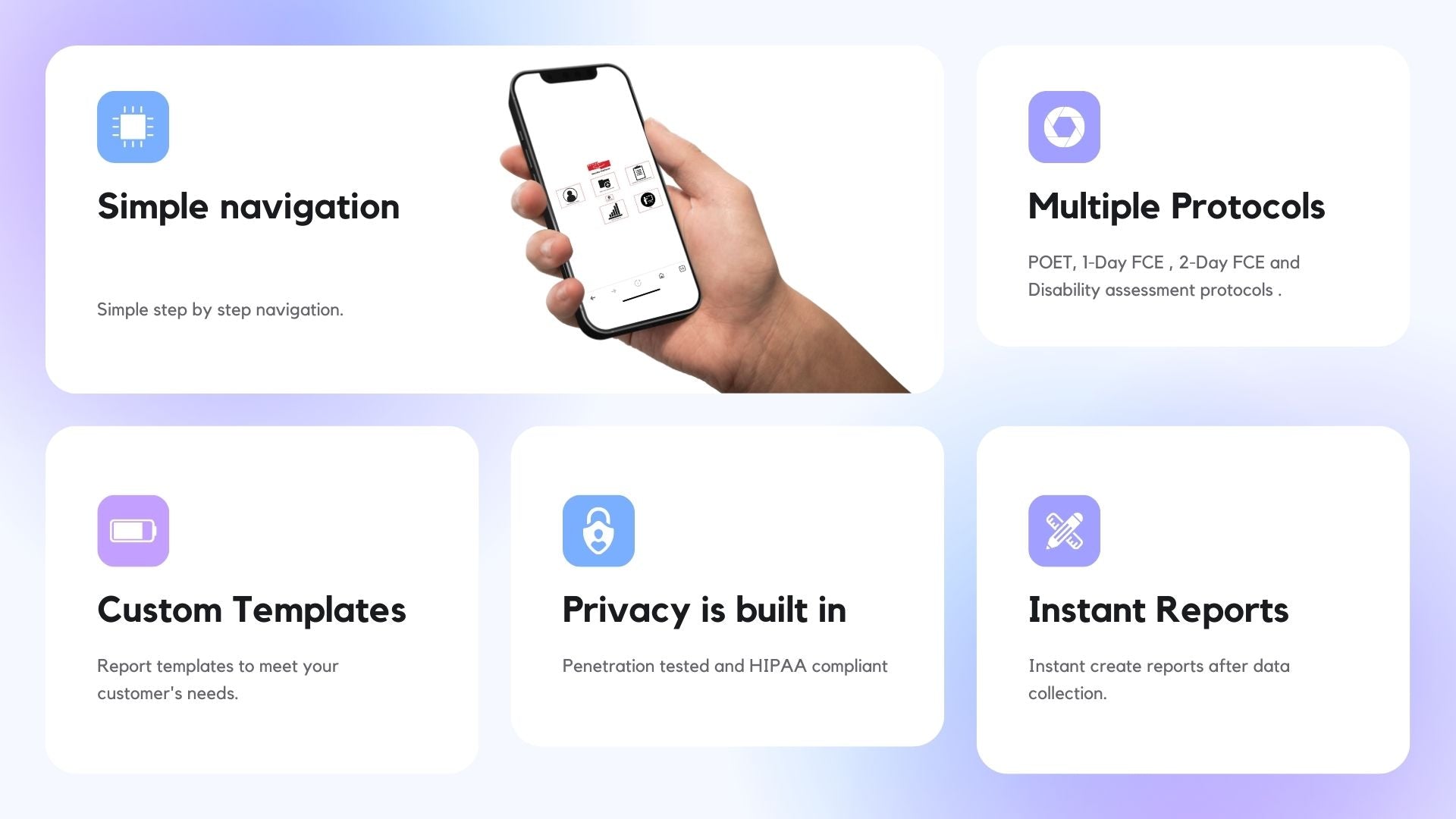
Metriks FCE software is designed to support the clinical workflow behind a Functional Capacity Evaluation.
Most people first notice the obvious software benefits:
- structured data entry,
- automatic calculations,
- dynamic tables,
- graphs,
- report paragraphs, and
- Microsoft Word report export.
Those features help reduce report writing time.
But experienced evaluators often care about a different question:
"Can I defend this report later if someone challenges it?"
For that question, raw data retention matters.
Metriks helps preserve the assessment record by retaining the underlying data entered during the FCE. That allows the evaluator to review the values used to generate the report, identify fields that were not completed, verify calculations, and access information that may not appear in the final narrative report.
This supports:
- quality assurance reviews,
- internal peer review,
- external report challenges,
- expert witness preparation,
- litigation support, and
- future review when the evaluator no longer remembers the case.
The value is simple:
Transparency beyond the final report.
Internal Links
Use this article as part of the Functional Capacity Evaluation content cluster. Recommended internal links include:
- What Is A Functional Capacity Evaluation?
- I Think Arrival Notes Are One Of The Most Important Parts Of An FCE
- Understanding Coefficient Of Variation In Functional Capacity Evaluations
- The 1 Rep Max Progressive Lift Test In Functional Capacity Evaluation
- Measuring Push And Pull Strength In Functional Testing
- Guidelines For Work Conditioning And Work Hardening Programs
- How To Get Approval For A Work Conditioning Program: A Texas Case Study
- Job Demands Analysis
Product And Course Tie-Ins
Frequently Asked Questions
Can a Functional Capacity Evaluation be used in court?
Yes. A Functional Capacity Evaluation may be used in workers' compensation, personal injury, disability, employment, accommodation, and litigation contexts. The evaluator may be asked to explain the methodology, data, observations, and reasoning behind the report.
What makes an FCE legally defensible?
An FCE is more defensible when it uses evidence-based methods, answers a clear referral question, matches testing to the injury and job demands, documents observations, preserves raw data, and explains how conclusions were reached.
Does FCE software make a report legally defensible?
Software can support defensible documentation, but software does not replace clinical reasoning. Legal defensibility still depends on test selection, evaluator expertise, job demand analysis, documentation quality, interpretation, and whether the conclusions follow from the data.
What raw data should be preserved after an FCE?
Raw data may include force values, lifting results, positional tolerance times, heart rate readings, RPE scores, pain ratings, range of motion values, questionnaire scores, calculation fields, incomplete fields, and notes supporting the final report.
What questions might an attorney ask about an FCE?
An attorney may ask what records were reviewed, how job demands were determined, why specific tests were selected, whether the worker gave consistent effort, what data supports the conclusions, and whether another evaluator could follow the reasoning from the record.
Should the final FCE report include every piece of raw data?
Not always. A final report should be readable and useful to stakeholders. However, the evaluator should preserve the underlying assessment data so that supporting information can be reviewed later if the report is challenged.
Why is job demand information important in a court or peer review setting?
Job demand information connects the worker's tested capacity to the actual work question. Without reliable job demand information, it becomes harder to defend conclusions about return to work, restrictions, accommodation, or work conditioning needs.
What if the job demands are incomplete or not employer-verified?
The evaluator should document the limitation clearly. The report should identify whether job demands came from the employer, worker interview, job description, DOT, O*NET, ORS, or another source. Transparency is better than pretending the information is stronger than it is.
Does a legally defensible FCE have to follow a fixed protocol?
No. A fixed protocol may be useful in some circumstances, but defensibility depends on whether the evaluation is clinically appropriate, evidence-informed, relevant to the referral question, and properly documented. A situation-specific approach may be more appropriate than a one-size-fits-all battery.
How should I prepare if an old FCE report is being challenged?
Review the final report, raw data, referral question, records reviewed, job demand information, test results, observation notes, calculation methods, and any correspondence related to the evaluation. Reconstruct the reasoning from the documentation rather than relying on memory.
Related Articles
- What Is A Functional Capacity Evaluation?
- I Think Arrival Notes Are One Of The Most Important Parts Of An FCE
- Understanding Coefficient Of Variation In Functional Capacity Evaluations
- The 1 Rep Max Progressive Lift Test In Functional Capacity Evaluation
- Guidelines For Work Conditioning And Work Hardening Programs
- How To Get Approval For A Work Conditioning Program: A Texas Case Study
References
- Academy of Orthopaedic Physical Therapy, APTA. Current Concepts in Functional Capacity Evaluation: A Best Practices Guideline. Adopted April 30, 2018.
- MacMasters W, Allison S, Wickstrom R, McMenamin P. Functional Capacity Evaluation and Disability Determination. Academy of Orthopaedic Physical Therapy Independent Study Course 32.5.3.
- Texas Department of Insurance, Division of Workers' Compensation. Medical Contested Case Hearing No. 19005.
- Texas Department of Insurance, Division of Workers' Compensation. Medical Contested Case Hearing No. 12105.
- Texas Department of Insurance, Division of Workers' Compensation. Medical Contested Case Hearing No. 12071.
- Metriks. Position Paper on the Legal Defensibility of the Metriks Functional Capacity Evaluation Protocol.